LP/GP capital formation conferences
Emerging managers, placement teams and allocators in the same room. The Institutional Proof Gap was written for this stage.
Every GP, operating team, and founder is asking a version of that question. Most answer it with a budget. I am a CFO who has answered it from inside the seat and both sides of the table, and I teach the framework that gets you to an answer you can defend.
Fifteen years as CFO. $200M AUM across multiple vehicles. A $60M emerging fund launched. Companies from pre-revenue to $45M in revenue. Two published books. The sessions come out of real-life situations, not theory.
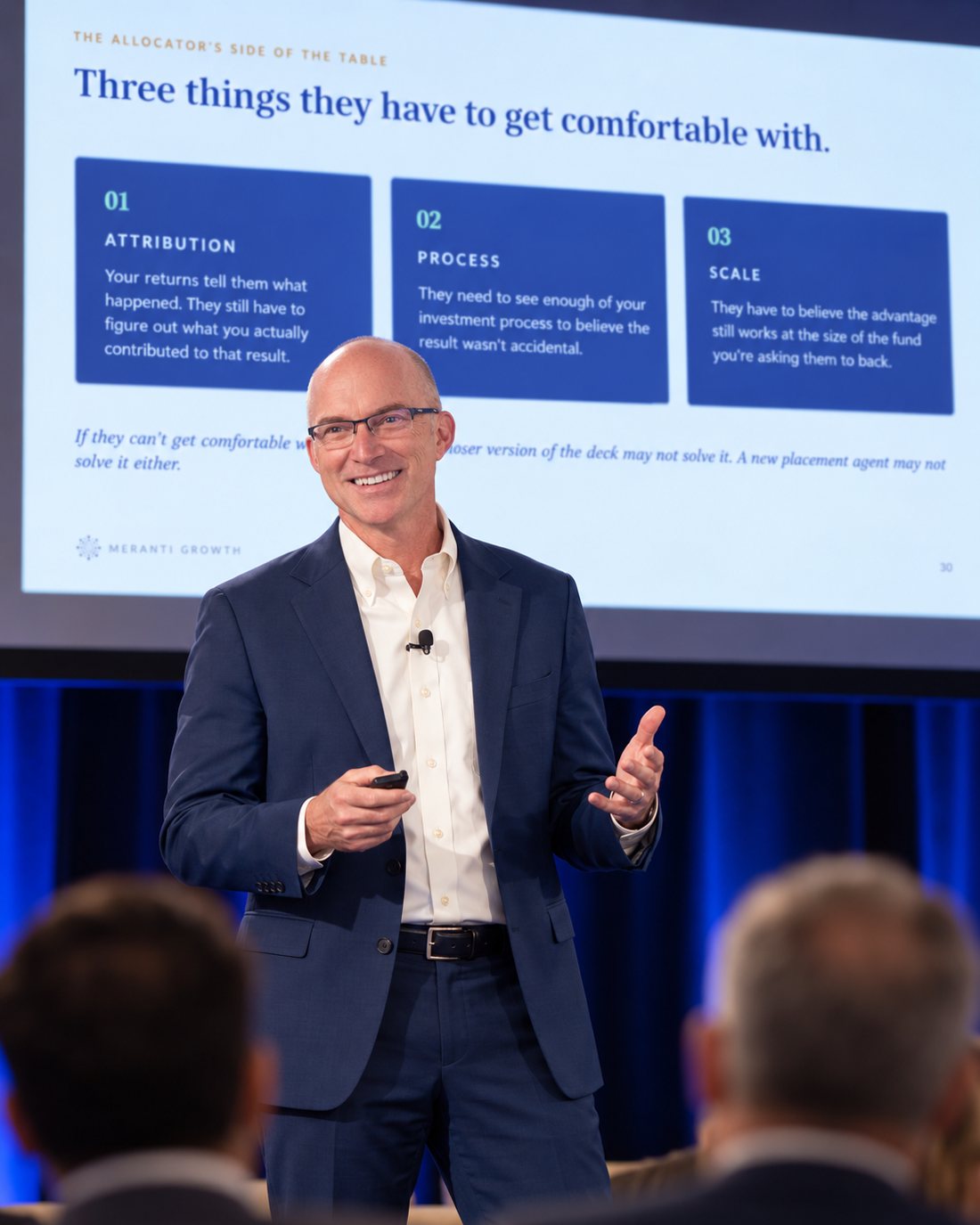
Four kinds of stage. Targeted material, scoped differently for each audience. Tell me which room you have and I will tell you which session fits.
Emerging managers, placement teams and allocators in the same room. The Institutional Proof Gap was written for this stage.
GP audiences working on attribution, repeatable process, and whether the edge survives the next fund size.
Cohorts heading toward a first raise, or the jump from converted pilots to a market that repeats.
Finance leaders who have to turn reporting into a decision the rest of the business will actually act on.
Why great returns still get a pass, and what closes the gap.
You showed them the returns. You showed them the strategy. The meeting went well. Then they passed. The problem is not the track record. You sold them a shiny object; they were trying to buy an engine that runs reliably for ten years, and most emerging managers never show them the engine.
MOIC, DPI, IRR and the funnel are a scoreboard. The scoreboard says what happened. It does not say why, and attribution is what an allocator is actually underwriting.
Agreement with your thesis is not the same as understanding how you invest. The thesis gets attention. The process is what makes the result credible as something repeatable.
Bigger checks are not the same as a scaled strategy. If the drivers behind the returns do not scale, neither does the ability to manage more capital.
30 minutes, then a 60-minute debrief. Offered to every audience as the follow-on.
Each runs 45 to 60 minutes as a keynote, or expands into a half-day working session on the participants' own numbers.
Right money, right things, right time. A working method for deciding what to fund now, what to defer, and how to know within a quarter whether the spend did what it was supposed to do.
A one-page spend test to run against their current plan, and the milestones that should gate the next dollar.
Your first ten customers proved somebody will buy. They did not prove you have a market. How to tell the difference before you spend a Series A finding out.
A test for whether their traction is real, and the signals that separate an early adopter from a mainstream buyer.
Exit readiness is an operating discipline, not a transaction phase. What a buyer's diligence opens, and the work that has to be true eighteen months before anyone signs an LOI.
An exit readiness checklist scored against where their company stands today.
A keynote changes how a room thinks for a week. Training changes what a team does. I taught entrepreneurship at the MBA level for four years and I build sessions the same way: few ideas, worked through on the participants' own numbers.
GPs bring their attribution. Founders bring their model. Finance teams bring their close calendar. We work on what is actually in front of them.
Scope a programOne talk expanded into exercises. Participants leave with a completed worksheet against their own fund or company, not notes.
Built for accelerators and platform teams. Sessions build on each other with work between them and a checkpoint on each participant's progress.
For a team that disagrees about the numbers. Structured around the decision in front of them, with prep on their materials beforehand.
Same material, built for a screen: shorter segments, live Q&A throughout, workbook sent ahead.
No agent and no committee. You get me on a call, then you get a written proposal.
Who is in the room, what they are wrestling with, and what you need them to do differently afterward.
Session outline, format, what participants leave with, travel needs and fee. Within two business days.
I talk to two or three participants before the date so the examples are theirs. Slides and workbook delivered a week ahead.
Fee: $2,500 for keynotes, $5,000 for half-day and cohort work. Reduced rates for accelerators, nonprofits and university programs.
Request the detailsI was the CSO, the investment committee, the CFO, and the person an LP emails with a question that sits for nine days. Jeff took the last two. What I didn't expect was how much better the first two got once I wasn't doing the rest.
All of his models are exact, simple and operationally usable. He has the ability to coach controllers, accountants and admins to improve and execute operationally as a department.
Jeff was given a very difficult assignment: validate or disprove the viability of the core technology. He succeeded in his goal ahead of schedule and under budget.
Three books out of client work. Bulk copies for attendees can be included in a booking.

Not a fable. A step-by-step guide to selling a mid-market technology company: assessing readiness, creating competition among buyers, surviving diligence, and closing on terms you chose rather than accepted. Built on real transactions, with case studies from deals that actually closed.
Order a copy →Are you spending the right money, on the right things, at the right time? Two leadership fables answer that question from the two places a startup gets it wrong: marketing and operations.
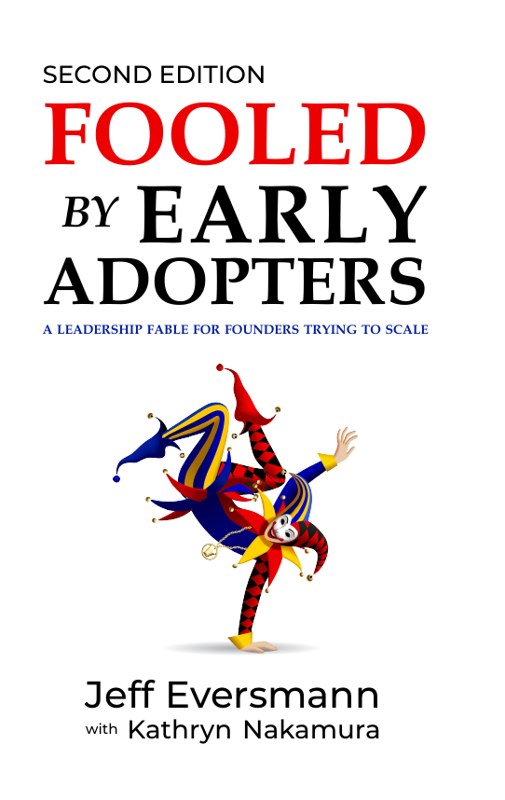
The marketing answer. Jonathan Reeves raised a Series A on the strength of a few converted pilots, chased the wrong customers, and six months later the money is nearly gone.
Order an advance copy →
The operations answer. Kat is the person everything runs through and nobody credits, spending her effort on work that keeps the company upright and never gets counted.
Get launch notice →I started as a computer engineer. Georgia Tech, ten years building systems, then a move to Austin in 2004 and a hard turn into finance. That path is why the sessions land with technical audiences: I have been the person in the room who understood the product at a deep technical level and now I bring that same depth to the P&L.
Since 2010, I have run finance for venture-backed, sponsor-backed and family-owned companies from pre-revenue to $45M in revenue. Three companies taken to a first GAAP audit. A quarterly close cut from thirty days to five. A $60M fund formed and launched, $17M in capital calls and $13M in distributions across 100+ investors in a single year, and CFO responsibility across $200M in AUM. I co-founded a seed fund of my own and advise early-stage startups.
Through Meranti Growth I do this work as an interim and fractional CFO for emerging managers and operating companies. The speaking is the same material, delivered to a room instead of a firm.
Date, audience, and what you need them to walk out doing. I reply personally, usually the same day.
One-sheet, speaker bio in four lengths, and a high-resolution headshot. One zip file.
Download the kit →
jeff@merantigrowth.com
Austin, Texas